
Is the United States Becoming a Techno Banana Republic?
The Trump administration banned Anthropic's Fable and Mythos models for a vulnerability GPT 5.5 also has. This isn't governance—it's competitors weaponizing state power against a rival.
On Friday, at 5:21 pm Eastern Time, the Trump administration imposed a sweeping export ban on Anthropic’s new Mythos/Fable models. It was hailed as evidence that even Big Tech companies might face consequences. Is this proof that my extensity argument isn’t true?

But, the more I read about the export ban, the more I realized that this probably wasn’t a sober, considered response to a real threat. At best, it was a classical case of Trumpian dick-waving and political posturing. But I also think there’s something else behind the export ban, and it’s a perfect example of tech extensity in action.
But first, let’s get the dick-waving out of the way.
Maybe it’s a Friday flex?
From Axios:
Anthropic had previously notified the government multiple times about the planned June 9 release of Fable—which is a general-use version of Mythos—and the government did not object, a source close to the company said.
Recall that Anthropic let the U.S. government, multiple cybersecurity researchers and companies like Amazon, Google, Apple, and Cisco test their powerful models for nearly two months prior to release (Project Glasswing). The government was also forewarned when the model would be released. They said nothing. There was never any talk about an export ban, or an announcement that Anthropic was forbidden from releasing its model publicly. Trump even doubled-down on his hands-off AI policy when he announced his anemic EO that established a completely voluntary framework for frontier AI model development that he emphasized was definitely not “a mandatory governmental licensing, preclearance, or permitting requirement for the development, publication, release, or distribution of new AI models.”
So, it was probably a bit of a shock for Dario Amodei when Anthropic received a call on Friday saying it had 90 minutes to take Fable and Mythos down due to the national security concerns about how foreign militaries in Russia, China, and other countries might use the models to harm the U.S. I mean really guys... you just woke up to this being a concern now?
Based on Anthropic’s recounting, the administration gave the company no further details at all, beyond the fact that Anthropic was forbidden from sharing the model with any foreign national, inside or outside the United States. In plain English, this meant anyone not born or naturalized in the United States was barred from using Fable or Mythos, including Anthropic employees, or individual companies or end-users. And they gave Anthropic 90 minutes to comply. This isn’t a serious response to a credible threat, it’s posturing. It’s the kind of thing you’d see out of Russia or Afghanistan, not a supposed democracy.
It’s been four days, and to date, the Commerce Department still has not publicly disclosed any details or further information on the order or the alleged national security concern (Reuters did receive a leaked copy of the letter, and has some interesting coverage here). The directive was reportedly issued by U.S. Secretary of Commerce Howard Lutnick, and the folks at Just Security speculate that the legal authority is likely based on the Export Controls Reform Act of 2018 (”ECRA”), which is the Commerce Department’s primary authority for administering U.S. “dual-use” export controls. This isn’t the first time Commerce has used the ECRA and specifically, its authority to privately “inform” U.S. companies that an expert license is required, but as Just Security noted “the breadth of this order is unprecedented.”
All of this was allegedly based on a single Amazon-reported Defense Oriented Prompting (DOP) attack that was relatively simple, according to security experts like Katie Moussouris who actually reviewed the report submitted by Amazon. Anthropic later explained:
We have reviewed a report that we believe is the basis of the government’s directive and validated that the level of capability displayed there is widely available from other models including OpenAI’s GPT-5.5, and is used every day by defenders who keep systems safe.
Even OpenAI brags about GPT 5.5 being a high-capability model for cybersecurity, similar to Mythos.
Taken together, it’s hard to see this as anything other than arbitrary and/or retaliatory against the company, given how the Commerce Department took the extraordinary step of banning Anthropic’s models by any foreign national use, regardless of location, for a capability that OpenAI’s GPT-5.5 also has. If this was truly about national security, where’s the export ban on ChatGPT? Notwithstanding Anthropic’s own hyperbolic marketing self-owns, I have a hard time taking the purported threat seriously. It reads more like pretext to advance the administration’s larger aims of punishing those who do not debase themselves sufficiently for Trump’s amusement. After the supply-chain risk debacle didn’t carry the necessary gravitas, Trump decided to escalate.
An alternative hypothesis: is the U.S. becoming a techno banana republic?
All of this aside, I think there is a second, far more interesting hypothesis for why Anthropic specifically is being targeted with this extraordinary act: what if it’s a signal from Anthropic’s competitors about who really has the power in this relationship. Again, from Axios:
Amazon called administration officials Thursday night to share a report showing how they were able to jailbreak and access portions of Anthropic’s powerful new Mythos model that pose a national security threat, sources familiar told Axios. … - But calls from Amazon—as well as at least five other companies to a variety of senior administration officials Thursday evening and Friday morning—led to the model being shut down by Friday night.
Read that again: Amazon, and five other unnamed companies, appear to have at least instigated, if not outright triggered the Department of Commerce to issue an unprecedented ban against Anthropic’s most powerful AI model to date. Ordinarily, when a vulnerability is discovered, the proper course of action is to report that vulnerability to the company responsible so they can at least have a chance to fix it. There’s even a term for it -- responsible disclosure.
Maybe that happened and Anthropic ignored the disclosure, in which case, they’re in the wrong --but at that point, why wouldn’t Amazon or the administration be saying that publicly? Based on the news currently leaking, Amazon et al. didn’t ring up Anthropic to report a bug--Andy Jassy ran to Treasury Secretary, instead.1 Another thing that bugs me here is that Amazon and many other companies had two months to share those concerns and address this directly with Anthropic before Mythos/Fable was released.
It’s hard not to see this as some kind of power play, or as an example of my larger extensity argument. In How Big Tech Becomes Ungovernable, I wrote:
In a normal, healthy capitalist system, customers, shareholders, and regulators decide with their wallets and their rules who lives and who dies. Fit, beneficial, lawful, and productive companies survive, unfit, unlawful, or unproductive companies go bankrupt or otherwise cease to operate. And historically, this has mostly been true….
But we’ve never faced capitalism in a world where a handful of companies have managed to amass the level of power and wealth that exist today, with the ability to engineer systems that are so intertwined and spread across so much of our lives. The technology on the market today is becoming too big to control.
Right now, there are no real barriers—no meaningful bulwarks or disincentives to stop what appear to be a handful of men from essentially owning all of us….
There’s also no accountability either, because everyone with the power to actually do something is too busy using the tools they’ve sworn they’ll regulate. Yes, we’ll get a few token fines, or threatened actions here and there, but that’s part of the theatre. Yes, the companies might pretend to be chastened for a time, but that will only teach them to be less obvious about their intentions.
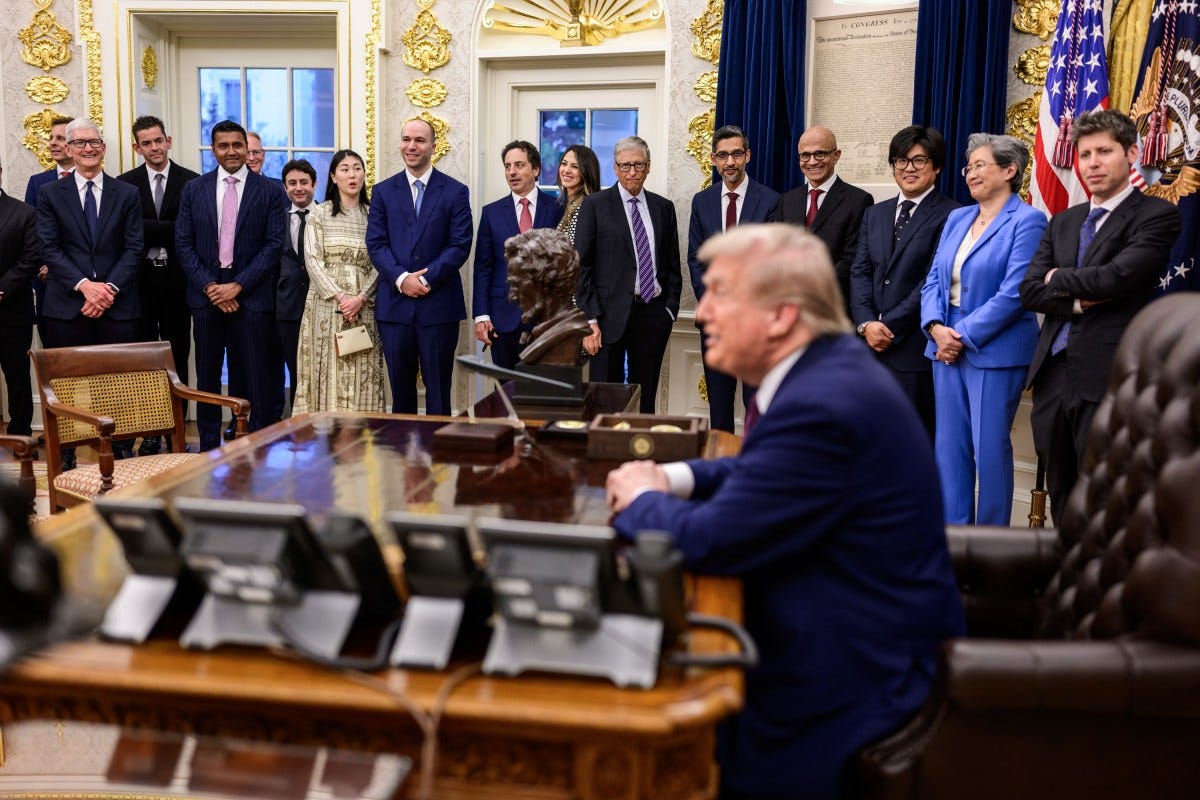
The simple fact is, Anthropic is (or maybe, was) attempting to do the right thing by providing researchers, including the U.S. government and direct competitors, with pre-release access, and now it’s being punished by companies who would rather engage in a race to the bottom. People think that the Trump administration (i.e., the entity granted de jure power through the electoral process), is the one controlling the show, but in practice, episodes like this make him look more and more like a puppet. Probably for one or more of the guys who attended this meeting):
I don’t honestly know what the real angle is. I can speculate, but I don’t have a smoking gun. Occam’s razor (the White House suddenly waking up to an obvious security threat) could actually be the only motivation after all. But all of this smells very off to me.
If I’m right, the people with the real power have found in Trump an easily manipulated (albeit slightly chaotic) powerful dupe, willing to exert the full force of the U.S. government to tear down their competitors and smite their enemies in a way that keeps their hands (relatively) clean. They may not yet have guys with guns who can enforce their will2 but that may no longer be necessary. America is, for better or worse, descending into a techno banana republic. The president may still be the notional figurehead, but it appears that Amazon, OpenAI, Meta, Oracle, and SpaceX are the ones with the real power.
This is especially strange given how Amazon has invested at least $8 billion in the company, and has committed to invest as much as $25 billion overall.
Although Elon Musk appears to have at least some control over actual murder drones.
great read loved the honest perspective.
you brought up great points.
not sure where this goes from here, but awareness articles like this are important for the discourse.