
On Censorship, Friction, and John Perry Barlow
Why wanting a little tech friction != equal censorship.
I’ve been on the internet for a long time. Not to date myself, but let’s just say that when I first went online:
I was not yet able to drive.
NCSA Mosaic (which later became Netscape) had just released the first widely-adopted web browser.
There were less than 3,000 websites on the World Wide Web. Also, the internet was still being referred to as The World Wide Web.
John Perry Barlow (who co-founded the EFF) had not yet released his iconic A Declaration of the Independence of Cyberspace.

You’ve probably seen Barlow’s Declaration before. It starts out like this:
Governments of the Industrial World, you weary giants of flesh and steel, I come from Cyberspace, the new home of Mind. On behalf of the future, I ask you of the past to leave us alone. You are not welcome among us. You have no sovereignty where we gather.
At the time, the Declaration resonated with me deeply. Here I was, a tech-curious teenager, growing up in a world that had in a few decades gone from analog to digital, and from information being locked in libraries and gatekept by adults, to being ubiquitous and always available for anyone with access to a modem. Information should be free, and censorship was bullshit. The internet didn’t need laws. Laws were for the puppets in meatspace.
You claim there are problems among us that you need to solve. You use this claim as an excuse to invade our precincts. Many of these problems don’t exist. Where there are real conflicts, where there are wrongs, we will identify them and address them by our means. ...
In the United States, you have today created a law, the Telecommunications Reform Act, which repudiates your own Constitution and insults the dreams of Jefferson, Washington, Mill, Madison, DeToqueville, and Brandeis. These dreams must now be born anew in us.
His manifesto was right about so many things. The laws of the late 90s and early 2000s struggled to keep up with the changes and the realities of this new world. They were vague, overbroad, and usually written by prudish politicians who had never even opened a web browser, much less understood the new environment we were all living through. There was quite a push by legislators for truly awful, censorious laws, and I still believe now as I did then that early efforts by organizations like the ACLU and the EFF to push back against these laws saved the internet.
More importantly, even though real problems existed on the early internet, there was always the promise that they could also be solved on the internet.
Where there are real conflicts, where there are wrongs, we will identify them and address them by our means. We are forming our own Social Contract. This governance will arise according to the conditions of our world, not yours. Our world is different.
“Governance will emerge,” he promised. And for a time, I believed him.
Growing up
Barlow died in 2018 at the age of 70, years before large language models, deepfakes and non-consensual intimate imagery. He didn’t bear witness to the wide-scale data breaches that happen so often now that we don’t even clock them anymore. He missed the avalanche of AI slop, mis- and dis-information at scale, and the dystopian rise of surveillance pricing, data brokers, and automated discrimination. He also won’t have to live through what’s likely to come over the next few years: the continued erosion of our privacy, freedoms, and autonomy due to the growing dependence we have to a handful of largely ungovernable tech companies and the tools they provide.

I wonder if Barlow would have stood behind all the precepts of his Declaration if he was still with us today. I don’t know. Perhaps he would.
Unfortunately, I know that I’m a different person than I was then. Being a young woman online in the late 1990s and early 2000s was … interesting. I had my fair share of creeps, weirdos, and trolls to handle of course, but it was still mostly human-scale, and could be managed.
I remember once, for example, how I had annoyed some internet dweeb by rejecting his dating advances on a MUD we were both on. Rather than accept the rejection with grace, he responded by finding an image of a woman doing something unseemly with livestock online, and plastered my name, home address, and parent’s business phone number with the image on a message board, with instructions to call me for a good time.
I was 17.
My parents were bombarded with calls, which eventually died off after they got over the shock of having to explain to grown-ass men that this was a prank, that I was a teenager, and no, we did not live on a farm. Separately, I tracked him down, notified his parents, the authorities, and the message board mods, and had him kicked off the MUD. Like I said, the abuse was real, but it was manageable. I suspect he never pulled this kind of thing again.
I cannot imagine what a 17-year-old me would have done now, in a world where it’s both easier, cheaper, and more impactful to be an asshole. And where he probably wouldn’t have been kicked off of X had he done the same thing.
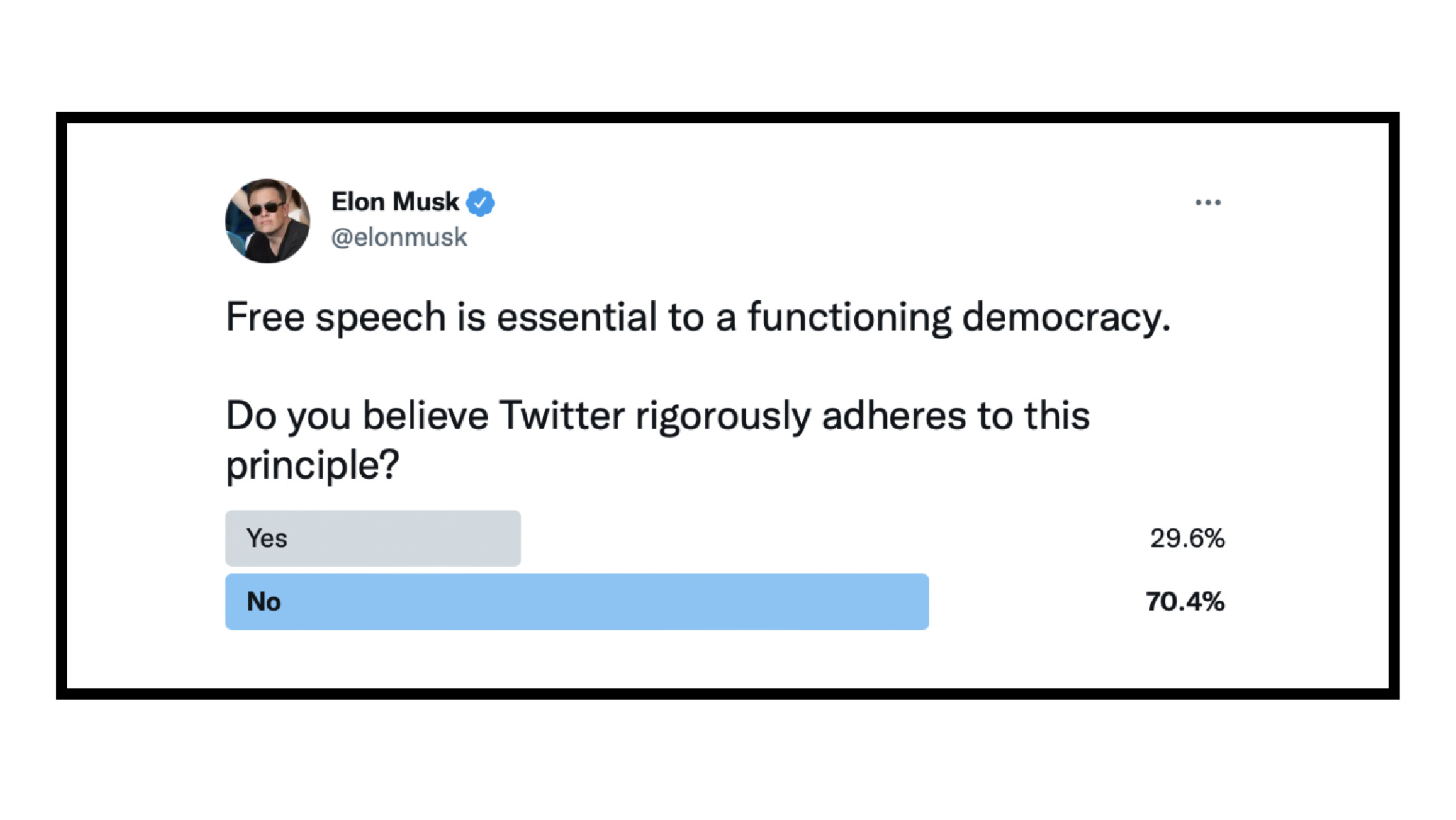
So many of of the problems that didn’t exist in the early days of the internet, do exist today. There is just too much awful out there in this world that hasn’t—or can’t—be resolved by forming a new ‘Social Contract’ on the internet, because there are enough bad-faith actors out there whose concept of a social contract is to shrug and decide that if the problem doesn’t affect them, it’s not really a problem. Or, that attempting to mitigate the problem is literal censorship:
The thing is, I still run into Barlow-types today, and as much as I try to channel my inner proto-hacker and see where they’re coming from, I just don’t get it anymore.
In the old days, we had friction. My nemesis’ impact was limited. He lived far away, photoshop and Grok didn’t exist yet, and he had neither the financial means nor opportunity to do something truly heinous and irreversible. But as technologies, and the growing interdependencies we have on them continue to grow, that friction will continue to erode. As I wrote:

Friction or resistance keeps our worst impulses in check. Friction helps keeps very human flashes of anger and frustration from cascading into catastrophic and permanent consequences.
But the loss of friction isn’t just from the tech itself anymore. The friction imposed by norms, democratic values, the rule of law, accountability, and well, consequences of any kind, have also been decimated, at least in the US. Functionally, a handful of techno-libertarians have absorbed Barlow’s manifesto, skipped over all the ‘woke’ parts about social contracts, ethics, the commonweal, and the Golden Rule, and are now unleashing their vision of freedom, which ends up being a disempowering hell for the rest of us.
Barlow was right — many of the promises he described in the Declaration have occurred. The internet is a world where billions may enter “without privilege or prejudice accorded by race, economic power, military force, or station of birth.” He’s also right that the technological tools now allow anyone, anywhere to “express his or her beliefs, no matter how singular, without fear of being coerced into silence or conformity.”
But I don’t think his grander vision ever came to pass. Specifically, this bit at the end:
May it be more humane and fair than the world your governments have made before.
I still don’t want censorship. But it would be nice to know that there’s something there to keep the worst impulses of the worst people in some degree of check.
PS: If you want to explore topics around tech extensity, ungovernability, gradual disempowerment, and power dynamics, please drop me a message. Or check out my fancy new consultancy page.
I hope we survive this phase we're in. Whatever it's called.