
7 Things I Learned at EAG London
I attended my first Effective Altruism Global event last weekend. Here are a few of my thoughts as a EAG virgin.
This past weekend, I attended Effective Altruism Global (EAG) London. For those unfamiliar, EAG London is one of the main events run by The Centre for Effective Altruism, an organization dedicated to supporting the larger Effective Altruism (EA) community. EA is best described as a movement that uses reason and evidence to find the most effective ways to, well, be altruistic.
Another way to think about it, is that EA is all about maximizing welfarist consequentialism. That’s certainly a fancier way of thinking about it, at least.
The EA movement has a few core cause areas they care about, which look really odd at first glance:
Animal welfare (particularly, farmed animal welfare)
Global health & economic development
Fundraising, evaluation of, and grantmaking to effective charities, and the evaluation of new cause areas (based on the Importance, Neglectedness, and Tractability (INT) framework)
Existential risk & long-term futures.
The last bucket—existential (x-risk) includes things like AI Safety & governance, chemical, biological, radiological, and nuclear (CBRN) mitigations, as well as long-term risks like AGI/ASI, extreme power concentrations, gradual disempowerment, and the moral status of digital minds.1
As I said, this all looks really strange—until you start doing the numbers and remembering that EA is a consequentialist worldview. The populations affected in these core areas stretch from the concrete to the theoretical. For example, billions of lives can be saved by funding interventions around global health and poverty alleviation. The suffering of tens, or even hundreds of billions of animals may be ameliorated by reducing/eliminating factory farms (between 80-100 billion animals, primarily fish and chickens, are killed on factory farms each year). Meanwhile, the long-term risk folks estimate that potentially trillions of sentient lives could be saved if we prioritize the prevention of suffering to beings in the far-future.
I slot somewhere in between the x-risk and long-term risk folks, but I am far more worried about the actual and near-term risks to humans living and born today, caused by the actions wrought by other humans and the tools they develop, over say, digital minds or sentient AI. I’m also less worried that super-intelligent AI will destroy humanity or make us suffer, because we seem perfectly capable and willing to do this anyway, even without AI.
Still, x-risk/long-term risk is generally where sub-areas like AI safety, governance & alignment, extreme power concentration, and gradual disempowerment sit within the EA framing, which is why I ended up in London.
Now, EA (and it’s less organized cousin, rationalism) aren’t new concepts for me. Anyone who has lived in the Bay Area for longer than say, a few months, has probably heard about EA/rationalism. There’s also a high probability that if you’re smart, worked for a tech company, went into STEM career, and/or attended a Bay Area house party or startup launch, you either are, or know someone who is an EA/rationalist. The Bay Area version of ‘six-degrees of Kevin Bacon’, is ‘six-degrees to William MacAskill or Toby Ord.’
Scott Alexander has a very amusing 2022 blog post titled ‘Every Bay Area House Party’, which riffs on this theme:
“Hi, what’s your name?”
“I’m Sara.”
“What do you do?”
“I quit my job at Google a few months ago to work on effective altruism. I’m studying sn-risks.”
“I can’t remember, which ones are sn-risks?”
“Steppe nomads. Horse archers. The Eurasian hordes.”
...
“And the effective altruists gave you a grant to work on this?”
“Not Open Philanthropy or Future Fund or any of those people, but I was able to get independent funding.”
“From who?” you ask, as if you don’t already know the answer.
“Same place every overly confident young person gets money! Peter Thiel!”
This is, obviously, deep satire. Scott is (I think, still) an EA, and Peter Thiel is mostly removed from the movement. But there are many kernels of truth here.
All of this, I hope sets the stage for what comes below. Here are a few of my takeaways from EAG London 2026.
An N=1 sample of what worked at EAG
Firstly, there’s a big difference between having a general understanding of a movement, and actually showing up to one of the “big tent” events. Attending EAG London for the first time felt like what I imagine going to a big Christian revival or the Democratic National Convention might feel like. Big, mildly overwhelming, and surrounded by a lot of people who are all very committed to the cause, the community, or both. Because they’re so committed, they are also very eager to share the good news. I’m not saying this with any shade or snark. It’s honestly infectious, and I can see why thousands of people descended on the InterContinental in London to bask in that vibe.
I continue to stand behind the statement that anytime you get a bunch of smart, diverse, passionate weirdos in a room together, magic happens. EAG London provided me with an excellent opportunity to workshop and refine my thoughts on tech extensity and how power concentration coupled with the loss of friction will disempower humanity. In two days, I met so many people who spoke my language, and came away with a notebook’s worth of new insights, questions to ponder, valid criticisms of my position, and crucially, affirmation that what I was working on actually mattered. For this alone, I will be forever grateful to the community.
EAs on average, also tend to be some of the most earnest and committed people I’ve ever met. Now, I think that some of the people I chatted with are still wildly idealistic and starry-eyed about how the world actually works, but that isn’t surprising, or necessarily a bad thing. Sometimes, it’s good to be reminded that wall of jadedness you’ve carefully constructed around yourself, might actually be a bit of an overkill.
Still, most people I chatted with were also curious, generous with their time, helpful, and willing to chat about things well outside their comfort zones. There was far more substantive engagement, and willingness to listen and help than I’d expected. It was the polar opposite of what I’d lived through in Washington, D.C.If you ever need someone to do ops—e.g., getting an event set up, checking in, or feeding a few thousand people in a conference center, getting people to the venue, organizing afterparties—just hire someone who’s run an EAG. I’ve attended many conferences, and most of the time, they’re a shitshow. Most conferences consist of long lines, overcrowded venues, few seats, and the persistent thought that you’d rather be anywhere else in the world than screaming over the din of hundreds of miserable people who are mostly just sharing variations about how much they hate their jobs.
The people who ran EAG London know how to get things done, and I couldn’t help but admire the efficiency. I have no idea what was going on behind the scenes, but from the outside, EAG London ran like the Dutch train system—on time, smoothly, with clear signage, lots of seats, and at a (mostly) reasonable decibel level.Similarly, this was the first time ever, where I engaged in two days of efficient, constructive networking.
I hate networking. Networking is a game, and I suck at the game. I have a hard time remembering faces and names, hate screaming over the noise, and don’t ooze the kind of big-dick energy/swager you need to be a master networker. But the EAG folks solved the gamesmanship of networking by creating an app where you can literally schedule meetings ahead of time with folks who are actually interesting! EAG London also had actual, legible name badges, and ample, well-signed meeting and quiet spaces. Ops took the toil out of networking, and that made the whole thing actually enjoyable.The overlap between neurodivergent folks and EAs/rationalists, while not a perfect circle, is tightly coupled. I suspect that this at least partly explains points 2-5. Coincidentally, there was an endless stock of Huel on hand, which almost certainly wasn’t an accident. It stands to reason that people who value maximizing efficiency and effectiveness also frequently extend that strategy to other parts of their daily lives, up to, and including sustenance.
That said, the organizers also provided a great spread of vegan food, which was actually well-prepared and tasty!
#7: The funding problem
This wouldn’t be a Carey blog-post if I didn’t have a but…
One thing that I’ve sort of been aware of for awhile, but didn’t really internalize until EAG, is the highly-concentrated donor base that funds most EA-led efforts. To round it down, pretty much the entire EA funding pipeline comes from two organizations: Coefficient Giving and GiveWell.
Coefficient Giving f/k/a Open Philanthropy and GiveWell/The Clear Fund, have mastered the art of getting rich people (and in particular, rich tech people) to part with their money. I suppose this isn’t a surprise if you think about it for a minute: you can’t be effective at your altruism if you don’t have any way to fund all the good works and worthy causes you want to support. The individual small donor model, while strongly encouraged, only goes so far, and, so obviously, getting billionaires to donate is important.
Still, I didn’t realize that these two organizations seem to be the exclusive funders of EA-aligned causes. For example, as of June 2025, Coefficient Giving and GiveWell directed more than $5 billion and $2.6 billion, respectively, in grants to EA-aligned focus areas. And here’s a chart from the EA Grants Database laying it all out by the numbers:
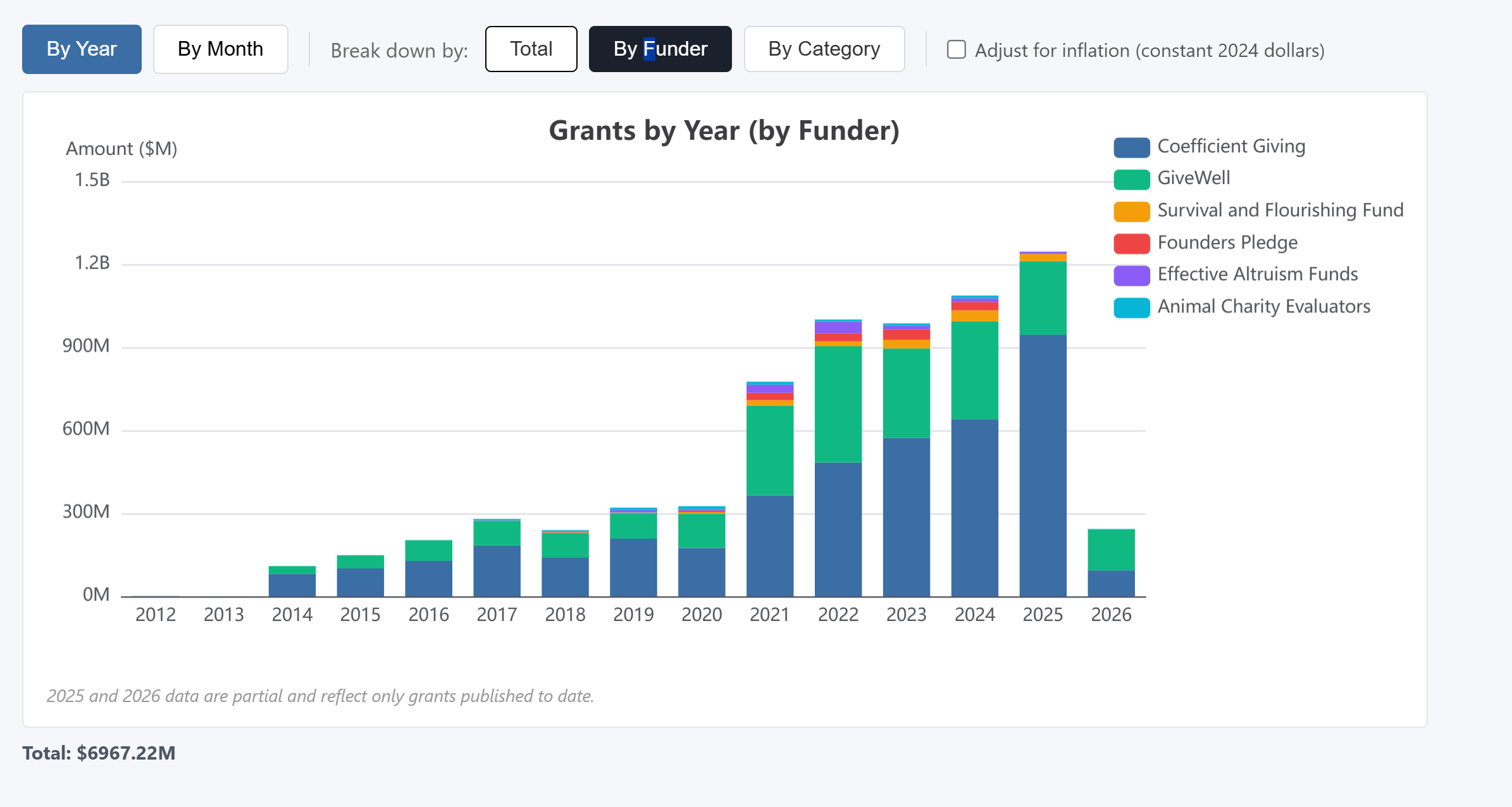
This raises many legitimate questions around bias, transparency, and even the evaluation criteria used by grantmakers to measure effectiveness. It’s reasonable to ask, as some within the EA community have, whether the priorities being supported by EA grantmakers are actually the most effective causes to support.
There was, for example, an overrepresentation of folks in AI safety & alignment cause area, compared to say, global health and pandemic preparedness. This isn’t unique to EA, but it is worth thinking about. It also really doesn’t help that so much of the earlier EA movement was tightly coupled with one donor in particular: Sam Bankman-Fried.

I need to sit with this a bit more, because many of the organizations I’m interested in working or collaborating with necessarily receive some / all of their funding from CG/GW, and I also recognize that writing about wealth and power concentration may … alienate me from the kinds of people who could meaningfully influence the gears of power and force actual impact.
So, while the Peter Thiel joke Scott made was off-the-mark (Thiel openly discourages billionaires from donating to charitable organizations), it still lands because it’s not that far off in principle.
Anyway, I look forward to chatting with many of the people and groups I met at EAG London, and attending future events. This was by far, one of the most productive, and dare I say it, effective conferences I’ve ever attended.
To all the folks I met at EAG, it was great. And thank you in particular, Katalina Hernández for cajoling me to go :D
There is a lot out there about EA, and I can’t hope to do it justice. If you’re new and interested, sites like effectivealtruism.org and 80000hours.org do a vastly better job explaining EA.
While you are correct to note that CG and Givewell are vast majority of EA funding at present, some sizable grantmakers such as Macroscopic do not publish financial data and aren’t included in the database.
This comment is the most concrete info I’m aware of on how much Macroscopic gives: https://forum.effectivealtruism.org/posts/dm2uawLLeLbY8WNKM/updates-on-the-effective-giving-ecosystem-mcf-2025-memo?commentId=cTgtAHKzimvdAs6oQ
Thank you for the insight! As someone about to go to their first conference solo, this was encouraging to hear ( I also hate networking).