
On Numbing Out
A stream-of-consciousness mental reflection on a great piece of writing.
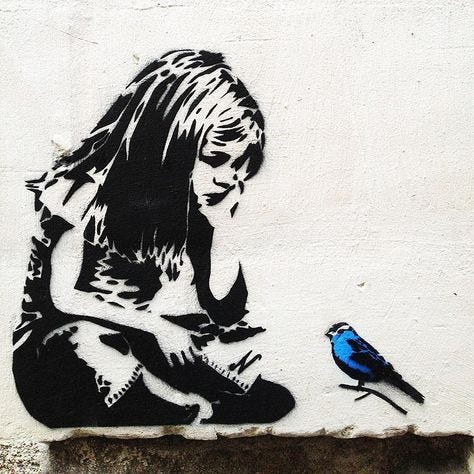
I don’t know how the Substack algorithm got my number quite so quickly (perhaps Notes matter?) but all I can say is that this popped up on my feed, and Catherine Shannon and I are on the same wavelength.

The numbing out effect she describes in this piece is everywhere, and it’s only gotten worse. She wrote this in 2023, when many of us still had some degree of hope and optimism. AI was burgeoning. The climate wasn’t as bad. Biden was president. There was still rule of law. Now?
Well, now everything is chaos.
She writes:
Life has gotten very chaotic incredibly quickly. It has become increasingly difficult to parse anything from the static. People started coping with this lack of meaning through a kind of ironic detachment (which is very much still around), but it has matured into a pervasive cultural apathy, a permeating numbness. This isn’t nihilism per se. (Even nihilists have a sincere belief system; they just sincerely believe that life is meaningless.) What we’re dealing with is worse than nihilism. People are checking out of life in their 20s and 30s without reaching any profound conclusions about the point of it all. …
The picture is bleak. It’s so sad it’s difficult to comprehend. How do you protect yourself in such a world?
You simply don’t allow yourself to experience it.
I’ve been thinking a lot lately—well, ok, I’ve been ruminating a lot—about privacy nihilism, and apathy more broadly. I’ve been mulling over my career, AI safety, existential risk (the real kind, affecting us now, not the can plants feel pain or sentient robots kind). I’ve been thinking about the future, and my role in it. And how I want to find something purposeful and meaningful to do with the short bit of time I have left. Something that goes beyond checklists or checking out.
I’ve been thinking about law, and the fragility of architecture built on nothing but norms and (mostly) implied physical threats. At their core, laws are nothing more than idealized pinky swears wrapped up in a social contract. Sure, there might be guys with guns and courts who can/might theoretically enforce this contract in the abstract sense, but enforcement through the barrel of a gun quickly runs into scaling limits. So the thing that separates us from total anarchy & lawlessness is an implicit assumption that we’ll all do our parts and generally play nicely with one another.
I’ve been thinking about what happens when institutional structures start to fall apart, and bloated, janky systems. I’ve also been thinking about power. Who has it, who doesn’t, why the powerful are powerful, and how that changes the dynamic of life. I’ve been thinking about how so many in power are so destructive with that power and how this feels an awful lot like the Gilded Age again.1

Like Catherine, I’ve been thinking about the impact of being constantly online, and the structures that have been developed to mediate and control us. I’m seriously starting to wonder if Catherine’s conclusion here has reached the event horizon, and has become an irrefutable truth:
We can’t put the internet back in the box or log off forever. Too much of our lives is irrevocably online, we’re all too self-aware, and a saccharine glaze of sincerity is too affected to feel real. Besides, we’ve all been cornered by the guy at the bar with a well-worn paperback in his pocket who locks eyes with you and whispers, “But how are you, really?” as if it’s a profound question. I would hate to subject anyone to such an encounter.
I’ve been thinking way too much about famous uprisings and impactful people—the British and American quakers who boycotted sugar to protest slavery. Sinclair Lewis and The Jungle. All the various labor movements throughout the 18th-20th centuries. Banksy. The fictional Butlerian Jihad of Dune.
So much of Catherine’s post on numbness resonated with me, but I thought this was particularly salient, given my recent note on boldness:
Standing for something is hard because what you’re implicitly saying is, “I don’t necessarily stand for all those other things over there.”
I’ve been thinking hard about how not to fall into the apathy trap, or at least how to pull myself out of it. I want to stand for something, even if it makes me a target. Even if it forces me to accept that I don’t stand for all the other things. But what to focus my finite time and energy on? So much of the world is deeply, profoundly fucked up. Isolating oneself to a single blindspot, a single cause, a single broken thing that needs mending is hard to do. Otherwise, we’d all be doing it, right?
I’d like to believe that I can do something with the set of skills I have, and in particular, my research and writing and ability to engage with so many different, interesting weirdos. Whether this is through writing directly, or a combination of other things is TBD. I’m mulling over starting up salons to get other brilliant people in rooms together.
But I do know this much: I don’t want to be numb anymore. And you shouldn’t, either. Read her piece, and let’s think together about what’s next.
Except unlike in past Gilded Ages, all of the powerful elites here have bunkers and safehouses and large contingents of armed guards and can avoid losing their heads (figurative or literally).