
Rock Solid Stupidity: Wyoming's GRANITE Act
Sometimes legislation is so dumb, it needs the full Carey treatment. Ladies and gents, I present to you, the Wyoming GRANITE Act.
Yesterday, Tobias Mark Jensen shared that a new dumb bill had been proposed in the Wyoming State legislature. Dumb laws and American politicians go together like alcohol and bad decisions, and I normally don’t bother reading or writing about them because life is short.
Still, this one had a catchy title. The Wyoming Guaranteeing Rights Against Novel International Tyranny and Extortion (GRANITE) Act. Immediately, something in the back of my brain went off, signaling to me that this was … strange, but I couldn’t put a finger on it at first. All I could think was ‘Why the hell is a free speech law coming out of the Equality State called the GRANITE Act?’
I promise, I’ll get to that in a bit, but first, I want to tear into this baby. Or rather, I’ll say, Claude and I are going to tear into this, mostly because I’ve modeled my version of Claude to be as snarky as I am. This is all written by me, but Claude pointed out some very interesting points that I’d missed, which I note below.
I freely admit that while I practiced law in the US, and know a bit about EU law, I am not a Constitutional scholar or an international law expert by any means. Neither is Claude, but then again, it’s probably smarter than the politicians who drafted this obviously unconstitutional bill, so… YOLO
All hat, no cattle (or logic, or reason)
So the Tl;Dr of this bill is as follows:
AN ACT … creating a cause of action against foreign states and international organizations regarding foreign censorship laws that violate specific constitutional provisions
If that wasn’t obvious enough, it’s basically a broadside against Big Tech regulation or enforcement. In fact, the law explicitly calls out the UK Online Safety Act and Ofcom’s letter to 4chan threatening fines of $25,000,000, and the Brazilian Supreme Court’s order against X and Trump’s Truth Social forcing the companies to censor certain user accounts in Brazil. For you see, the drafters in Wyoming are very concerned that all those nasty foreign laws “threaten[] Wyoming’s leadership in decentralized finance and digital assets”, which is a little weird?
So, four Republican Freedom Caucus politicians (naturally), Daniel Singh, Ken Guggenmos, Scott Heiner, and Bob Wharff hatched this big, beautiful bill to protect Wyoming citizens, businesses, or, well, anyone who casually intersected with the state physically or digitally, ever.1
A word of advice to politicians everywhere. Don’t write laws like this.
Reader, I want you to take a moment and close your eyes. Pretend you’re a Wyoming politician. You’ve dismounted from your horse, set your cowboy hat on the table, poured yourself a full measure of Wyoming Whiskey, loaded up your nearby firearm2, and you start drafting.
You want to craft a law that will help Wyoming stand for freedom from tyranny (except, y’know, if you’re trans or want an abortion), protect free speech (except if the speech is about sex, gender-identity, or its speech you personally don’t like), and also to defend America from Europe. But mostly, you want to gin up lots of likes on X and guarantee prime-time interview slots on Fox News and One America News Network. So, you realize that to get those coveted slots, you’ve gotta go big and really swing for the fences.
But really, I’ve got to say, if you’re trying to make your mark, you might want to at least avoid strangling your bill before it even gets to committee. In other words, you probably should avoid writing something like Section 1‑44‑104(b) and (c):
1‑44‑104. Cause of action; statute of limitations; construction.
(a) A plaintiff described in W.S. 1‑44‑105(a) shall have a cause of action, to the extent permitted by federal law and subject to subsections (b) and (c) of this section, against any foreign state, international organization or any officer, employee or other person thereof acting within the scope of their official duties who has threatened to enforce, attempted to enforce or enforced a foreign censorship law against the plaintiff in a manner that would violate the first amendment of the United States constitution, Article 1, Section 20 of the Wyoming constitution or Article 1, Section 21 of the Wyoming constitution.
(b) The cause of action under subsection (a) of this section shall apply only to the extent permitted by federal law, including the Foreign Sovereign Immunities Act and the International Organizations Immunities Act and any applicable headquarters agreement, treaty or executive order.
(c) Nothing in this chapter shall be construed to:
(i) Waive the sovereign immunity of any foreign state or international organization;
(ii) Limit any exceptions to sovereign immunity available to the plaintiff under the federal Foreign Sovereign Immunities Act;
(iii) Limit any right of a defendant to remove the case from state court to federal court as provided by federal law;
(iv) Limit any defense available to the defendant under federal law;
(v) Regulate foreign states or international organizations or to conflict with the foreign affairs powers of the United States.
(Emphasis all mine)
I mean, savings clauses are in every piece of legislation, but this isn’t a savings clause so much as a ‘gutting clause’. How do you sit down, write this and not think to yourself, ‘Hey… Is my law even a law at this point?’
Section 1-44-104(b) is a self-destruct clause. Between good old-fashioned federal preemption, FSIA explicitly gives foreign sovereigns near-blanket immunity with narrow exceptions (commercial activity in the US, tortious acts causing injury in the US, terrorism etc.). If the Paris police conduct a raid against the Paris office of X, to enforce against the creation and distribution of CSAM in France, the foreign law is almost certainly not going to fit into any FSIA exception, even if the administration further expands what free speech means or the ‘domestic terrorist’ classification. So the bill creates a cause of action giving internet trolls the right to sue over foreign censorship laws, then says lol, J/K guys. That’ll show the EU!
Section 1-44-104(c) doubles down on this by saying the bill doesn’t “waive the sovereign immunity of any foreign state or international organization” and doesn’t “regulate foreign states or international organizations or conflict with the foreign affairs powers of the United States.” So what does it do?
And then there’s the preemption problem. This bill also fails poorly at handling two different flavors of federal preemption under the US Constitution. First, there’s field preemption, which bars state laws that would allow, say a state court to evaluate or adjudicate over matters that are squarely in the domain of the executive branch. Like foreign policy.
But evaluating political systems and laws of foreign governments is exactly what this bill does —Section 1-44-106 specifically creates a presumption that foreign law being challenged is automatically a “foreign censorship law” then obligates foreign sovereigns to justify their own foreign laws to a Wyoming court. This is a textbook example of “intrusion by the State into the field of foreign affairs”3 which the Supreme Court has a long track record of finding unconstitutional.
Second, there’s conflict preemption which preempts state laws that would conflict with a direct interpretation of policy by the President, even where legislation is silent, or the conduct is merely indirect. Or, as the Supreme Court explained in American Insurance Ass’n v. Garamendi, 539 US 396 (2003), there’s going to be a conflict between the state and federal governments if a state takes "an iron fist where the President has consistently chosen kid gloves."4
That indirect bit is probably enough to torpedo this bill into the sun.…and the Supremacy Clause. Section 1-44-108(f)(iii) prohibits Wyoming officials from honoring Mutual Legal Assistance Treaties (MLAT) requests related to speech. But MLATs are ratified treaties — It’s right there in the name. That means under Article VI of the US Constitution, they’re the supreme law of the land. The bill’s “except as required by federal law”, is circular because complying with MLATs by offering mutual legal assistance in terms of handling an MLAT request is … exactly what “required by federal law” means. Guys. It’s in the name.
Oh, and let’s not forget our dear friend, standing and personal jurisdiction. Section 1-44-105(a)(iv) gives broad standing to “any United States person whose protected expression... originates from or is hosted on servers physically located in this state.” Any company in America could rent a server in Cheyenne and suddenly have standing under this act. Combined with Wyoming’s existing popularity as a corporate registration state and its deep interest in becoming the US’s pre-eminent destination for crypto/de-fi/DAO shenanigans, this is essentially creating a “censorship shield” flag-of-convenience scheme.5 Even in this administration, I don’t think federal courts will let this one fly.
Service of process by Truth Social Post or in the comments. Okay, so it’s not quite that stupid, but the GRANITE Act is pretty close. Section 1-44-105(d)(iii) allows service on an international organization “by publishing on a website maintained by an international organization, if the international organization is evading notice.” Due process and the FSIA both require service reasonably calculated to give actual notice. Mullane v. Central Hanover Bank, 339 U.S. 306 (1950). Which is to say, posting on, r/europe, in the comments section on a random EU website, or on X is unlikely to satisfy this standard. Though Ursula does keep pretty active on X, so…
The definition of ‘foreign censorship law’ and the cause of action requirements are hilarious. The definition of “foreign censorship law” in 1-44-103(a)(ii) requires the law to be “final, binding and enforceable” and to restrict expression based on “content, viewpoint or speaker identity.” But note: there’s no nexus requirement in the definition of what a foreign censorship law is, or where the predicate act occurred. Only where said law is ‘enforced’ in a rather expansive definition of that term.
As I mentioned above, this law would allow anyone who could claim some amount of Wyoming-ness to sue any foreign government provided that they allege that said foreign government “has threatened to enforce, attempted to enforce or enforced a foreign censorship law against the plaintiff” and Wyoming was vaguely involved. It doesn’t matter where the act violating said law occurs. All you need is a data center in Wyoming! But it’s even broader than that: currently, if some idiot from Wyoming went to Thailand, insulted the monarch in Thailand to his face, came home, and Thailand sent an angry letter alleging violations of Thailand’s lèse-majesté law, that idiot could then turn around and sue the Thai government for violating said idiot’s free speech rights under the GRANITE Act.The damages section is just bananas.
1‑44‑107. Remedies; liability.
(a) Upon proof by a preponderance of the evidence that a defendant threatened to enforce, attempted to enforce or enforced a foreign censorship law against a plaintiff in violation of the first amendment of the United States constitution, Article 1, Section 20 of the Wyoming constitution or Article 1, Section 21 of the Wyoming constitution, the court:
(i) Shall award the prevailing plaintiff:
(A) Actual damages as proven by the plaintiff or nominal damages if actual damages are not proven by the plaintiff;
(B) Statutory damages of one million dollars ($1,000,000.00) per violation, as adjusted for inflation under subsection (c) of this section or ten percent (10%) of the defendant’s annual United States related revenue, whichever is greater. Statutory damages imposed under this subparagraph shall not be less than the amount of any fine or penalty imposed by a foreign state or international organization regarding the foreign censorship law. …
(b) The remedies provided under this section shall be cumulative and shall be in addition to any other remedies available at law or in equity. The statutory damages provided under subparagraph (a)(i)(B) of this section shall be compensatory damages that are intended to compensate plaintiffs for harms that are inherently difficult to quantify, including chilling effects on protected expression, reputational harm, self‑censorship costs [Self-censorship costs, LOL—ed] and litigation costs incurred in defending against enforcement of foreign censorship laws and shall not be punitive damages.
(emphasis mine)
Right. So, it’s $1M per violation or 10% of the defendant’s annual US-related revenue, whichever is greater, and it can never be less than the foreign fine imposed. So if the EU threatens a 6% of global revenue fine under the DSA, the statutory damages floor is that amount. For Meta, that would be in the billions. The bill then labels these as “compensatory” rather than punitive in subsection (b), which, as Claude reminds me, is transparently an attempt to dodge two Supreme Court cases, BMW of North America v. Gore, 517 U.S. 559 (1996) and State Farm v. Campbell, 538 U.S. 408 (2003) which impose due process limits on punitive damages. Courts aren’t going to be fooled by that label — $1M per letter received is not “compensating” anyone for anything. The three Gore guideposts (reprehensibility, ratio to actual harm, comparison to other civil penalties) would demolish these numbers. These are just insane.
Inflation calculations make no sense.
1‑44‑107. Remedies; liability.
(c) The court shall adjust any statutory damages granted under subparagraph (a)(i)(B) of this section for inflation. The court shall calculate the adjustment for inflation by multiplying the statutory damages amount of one million dollars ($1,000,000.00) by the ratio of the seasonally adjusted M2 money supply value published in the federal reserve statistical release … [the section on M2 money supply values goes on for another paragraph]. …
(d) Except as required by federal law, including the Foreign Sovereign Immunities Act and the International Organizations Immunities Act, all defendants liable under subsection (a) of this section shall be jointly and severally liable for all damages incurred by the plaintiff.
So, I need to confess that I didn’t catch this at first, but Claude sure did! Section 1-44-107(c) adjusts statutory damages not against the Consumer Price Index (CPI) but the “seasonally adjusted M2 money supply value.” This is strange because nobody in normal legislative drafting reaches for M2 as an inflation adjustment. You use CPI. Nearly every federal statute that adjusts penalties for inflation uses CPI. State statutes use CPI. The Sentencing Guidelines use CPI. It's CPI all the way down.
By contrast, the M2 calculates the total amount of money in circulation (cash + savings deposits + equivalent instruments), which can fluctuate wildly based on Fed policy — it expanded roughly 40% between early 2020 and early 2022, which would have inflated the statutory damages from $1M to $1.4M in two years, not because of any change in the value of a dollar but because the Fed was doing QE. Using the M2 to account for dollar valuation in a court case would be nuts, which is why nobody does this.
But do you know who does use M2 to measure value? Take a guess… I’ll wait.
Though if you’ve figured it out and haven’t
subscribed already why not hit subscribe?


This is so transparently dumb
Did you guess crypto? Because it’s crypto!!!6
I had to read it again before I saw repeated mentions of blockchain,” “decentralized technologies,” and “digital assets” (Sections 1(i), (iv), (vi), (xv)). Which, like the GRANITE name smells funny because … WTF does crypto have to do with foreign censorship?
Thankfully, Claude got it in one:
The bill’s author, Preston Byrne, is a crypto/tech litigator. This is fundamentally a bill designed to shield crypto companies from foreign regulatory oversight, wrapped in First Amendment rhetoric. The EU’s MiCA regulation, which has speech-adjacent provisions around marketing and disclosure requirements for crypto assets, would arguably fall within the “foreign censorship law” definition because it “compels disclosure regarding expression.” That framing is doing a lot of heavy lifting.
I was dubious at first because it was the freedom caucus lads who wrote the thing — seeing as Preston Byrne appears to live in Connecticut.
For the unfamiliar, Byrne, is a rather vocal crypto & free speech lawyer (both in the US and UK) and prolific X poster, who has made it his mission to challenge crypto regulation, and age-verification laws like the UK Online Safety Act. He also represents 4chan in litigation against Ofcom. Byrne has made no secret about the fact that he is the father of the GRANITE Act, which, was basically cribbed from this blog post he wrote in October 2025. I shit you not.
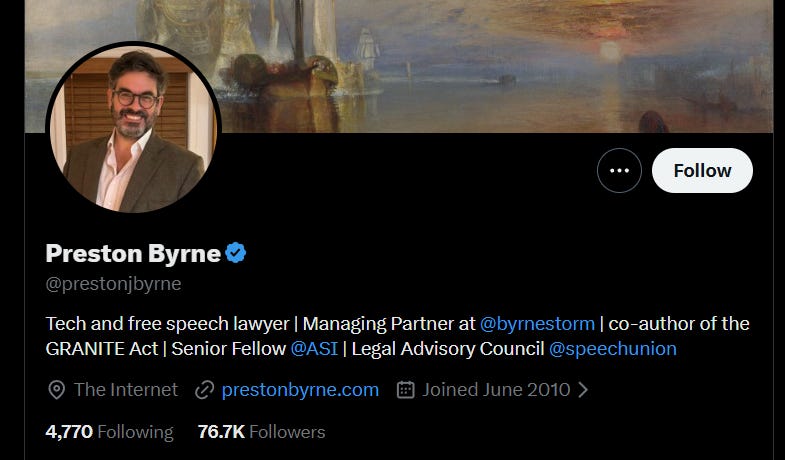
It turns out that he initially drafted this statutory turd for the New Hampshire legislature (hence the bacronym to New Hampshire’s state motto of ‘the Granite State’), but it looks like Wyoming was quicker to take the bait. He’s got a whole timeline here.
Admittedly, I am not entirely unsympathetic with his cause — I personally think the OSA, as well as most of the ‘save the children’ age verification bills and even parts of the DSA are terrible. They’re poorly implemented, ill-conceived, subjective, and rights-eroding. He and I are aligned in terms of ends, but my god, the means he’s using in the GRANITE Act are just galactic-levels of dumb.
And Jim Malcom of Common Sense Wyoming was even more blunt about it: he described it as “not Dan [Singh]’s idea, or even a Wyoming idea” but rather “the brain child of Preston Byrne,” a “legislative bait-and-switch by a D.C.-based crypto/tech litigator” that “promises free speech then delivers a shield for international crime.” Clearly, Jim isn’t a fan.
So, once again, we’ve got a state legislature (potentially multiple legislatures) being used as a vehicle for an out-of-state lobbyist’s pet project, dressed up in First Amendment language. This isn’t Wyoming legislators spontaneously deciding to protect “decentralized finance and digital assets” or even free speech from EU regulators. It’s an east coast tech lawyer shopping for a friendly legislature, and Wyoming’s existing crypto-friendly statutory framework (DAO laws, etc.) made it an obvious target.
Maybe someone doing the drafting realized this, which is why they stuffed it with “to the extent permitted by federal law” qualifiers throughout. The result is a bill that is either (a) unconstitutional where it purports to override federal law, or (b) superfluous where it defers to federal law. There’s very little middle ground where it does anything novel and simultaneously legal. It’s a messaging bill with a backronym, designed to generate exactly the kind of press coverage and X posts that Byrne has been living off of for years.
In closing, this isn’t just a dumb law. It’s a law that knows it’s an unenforceable turd, and was designed to look tough despite being entirely pointless. It’s the kind of thing I’d expect to see out of the Freedom Caucus.
Sadly, this is probably not going to be the only iteration we see: Byrne seems to have the ear of many conservatives and fellow crypto-shills in both the federal and state legislatures. We’re likely to see variants of the GRANITE Act pop up throughout the year.
The self-defeating structure of this law then is a feature, not a bug — it lets supporters claim they’re fighting foreign censorship without ever having to deal with the consequences of actually doing anything but tying up the courts with lawsuits filed by freeze peaches warriors and crypto cranks. I’m not exactly worried about these rock-laws, but I can’t look away either. The stupid burns so brightly, and we can’t shield our eyes.
So, now it’s time for you to tell me why I’m wrong by leaving a comment!
This lot tend to vote in a bloc for every predictable hard-right position imaginable.
I am not (only) being snarky here. All of these guys are very, very pro-2nd amendment, and it reflects in the bills they’ve introduced. I can only picture a loaded gun at their desks, just in case some trans person or ANTIFA walks into their office demanding an audience.
Under Zschernig v. Miller, 389 U.S. 429 (1968), the Supreme Court struck down an Oregon inheritance statute because it required state courts to meddle in the interpretation of foreign policy and foreign laws.
Honestly, this terse summary does not do justice to the complete insanity of the law at issue in Garamendi. To quote Wikipedia:
The Holocaust Victim Insurance Relief Act (HVIRA) … required that insurance companies in California that sold policies to people in Europe between 1920 and 1945 to go public with the records of their work during that time, "including the names of policy owners and the status of the policies."
A reminder that the urge to write ridiculous laws exists on both sides of the aisle.
I feel dirty for writing this, but Wyoming is so in the bag for crypto, that the state even minted its own crypto coin in January.
So Claude didn’t initially catch the M2 Crypto thing, but I did. But I had to include this line after I pointed this out to it:
Using M2 instead of CPI isn't just weird or ignorant — it's a shibboleth. M2 money supply is the crypto community's preferred inflation metric because it supports the "money printer go brrrr" narrative that underpins Bitcoin-as-inflation-hedge ideology.
Thanks for your comments. The drafters expect federal action on this issue very shortly.
When that federal action finally arrives it would be better to have a state law cause of action ready to go than on the drawing board. In the meantime, it is certainly no secret to us that the FSIA is a huge hurdle to get over - we did go to law school, after all, and I am litigating a case in D.C. on this exact issue against the UK's Ofcom in which Ofcom raised sovereign immunity as a defense - but it is not an impervious shield, and given the right fact pattern it can be overcome.
FSIA is also not the first and only hurdle a lawsuit against a foreign censor needs to get over. Your first hurdle in filing a lawsuit over foreign censorship is that you need a cause of action, and this bill creates one.
On the damages point, $1 million statutory damages was tailored to the scale of damages awards one can sometimes see in IP infringement cases. (My original proposal was $10 million but it was scaled down to address the exact concern you identified.)
In the foreign censorship cases the GRANITE Act is designed to address, the threatened fines from foreign states that seek to enforce their censorship laws in the U.S. are routinely in the millions - for failing to provide a report on its moderation practices to the UK, 4chan, for example, was threatened with criminal charges and statutory damages not to exceed 10% of its global worldwide turnover or £18 million (approx $24 million), whichever is greater. This mechanism is replicated by the EU Digital Services Act. GRANITE is designed to provide a damages award equal to the amount of the threatened foreign penalty, thus making the foreign penalty economically non-viable to enforce.
On the M2 point, nation-states do not buy bread at U.S. grocery stores. CPI is not the appropriate inflation measure. The intended effect of the "sword" provisions is to deter foreign censorship attempts. If foreign states will simply respect Americans' civil rights and stop sending letters to U.S. companies threatening their staff with jail time for constitutionally protected speech and conduct, there's no reason they should ever have a problem with a GRANITE-type law.
Finally, I'm not a lobbyist. I have been representing every target of foreign censorship laws who needs a defense, pro bono. My day to day work focuses on commercial contracts advice and commercial litigation, not political stuff.
We look forward to seeing what our friends in Congress are cooking up very soon.
I’m not sure this trash bill deserved your careful evisceration…but thank you! 🙏❤️